
DTF or sublimation for team jerseys: local names versus all-over designs
Choose between a local mark on a ready-made jersey and an all-over polyester design. Compare the artwork map, existing colours, names and ordering workflow.
Start with where the design needs to go. If you already have a suitable ready-made jersey and need a local crest, name or number, ask for a DTF assessment on that garment. If the design runs across the front, back and sleeves, ask a specialist about dye-sublimation and whether the garment will be made from printed panels. MIREN produces DTF. The fibre, existing decoration and intended coverage matter more than the label “sports shirt.”
Draw the design before deciding on the method
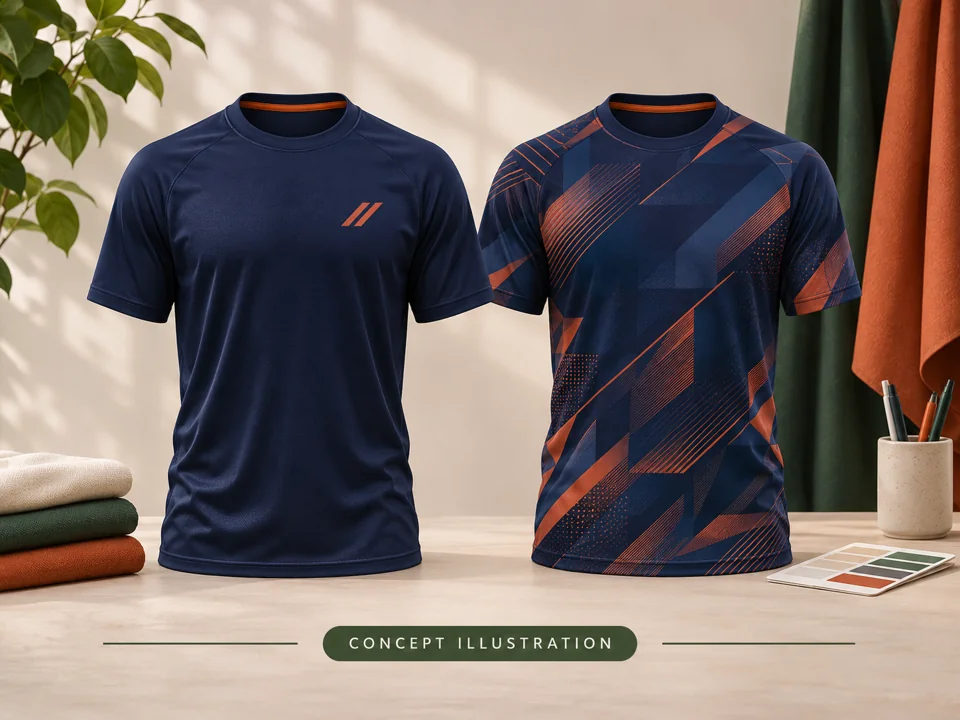
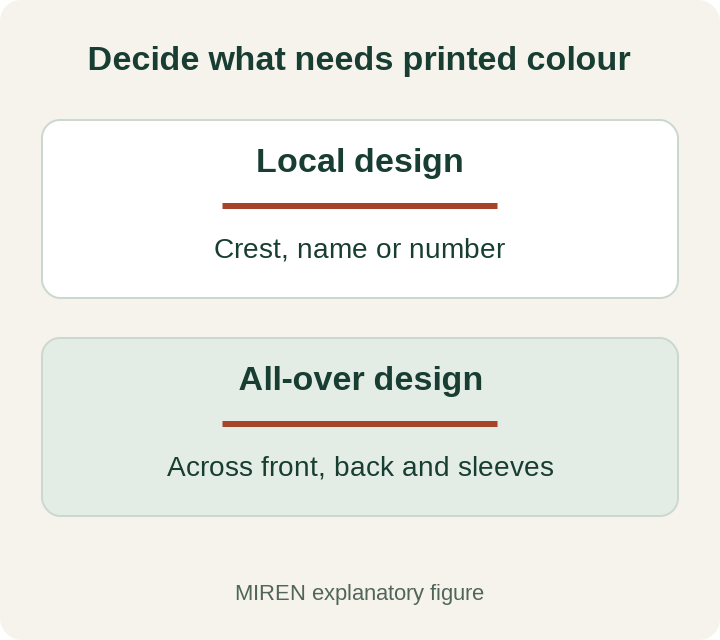
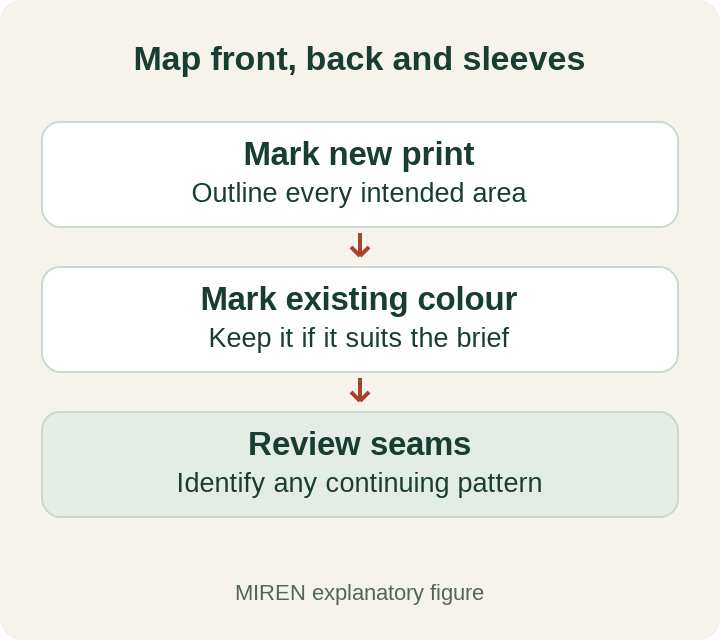
Give the team a front, back and sleeve sketch. Shade the areas where you want newly printed colour, then mark details that can stay as the existing garment background. A small sponsor logo and a player number are local marks even if you put them on different panels. A stripe that must run from the front into a sleeve or a pattern meant to cover the whole body is a different design request. Separate the requirements from the optional details. If the team's own colours can come from a stock jersey, the remaining artwork can be placed in selected areas. If the pattern itself defines the kit, the panel artwork and sewing layout become part of the purchase. Show which seams need to appear aligned, where names will sit and whether the same design must look continuous across sizes. Those points are easier to discuss before the garment is chosen.
Understand how the garment and graphic are made
DTF transfers a design from film onto the surface of the finished garment. It is a way to add a selected design where the material and construction suit the placement. Manufacturers such as STAHLS describe product-specific DTF compatibility and applications. The fact that one transfer is compatible with a fibre does not establish suitability for every mesh, coating or existing print. Give the printer the actual model and placement to review. In dye-sublimation, the design is transferred with heat, and the dye is intended for a suitable polyester substrate. Epson describes polyester or polyester-coated materials for its dye-sublimation process and recommends starting with a light polyester base for textile designs of this kind. An all-over sports kit often uses printed panels that are cut and sewn into a garment. Ask the actual supplier to explain its process, since applying a graphic to a ready-made blank and manufacturing printed panels are different jobs.
Compare the practical workflows
For a local job on a ready-made shirt, identify where a crest, back number, name or sleeve sponsor sits. Mark the width and show nearby seams. Check the same positions on the smallest size and note if the design will sit over perforations, an elastic panel or a previous print. If the existing stock already has the colours you want, the local artwork can leave the rest of the garment visible. For a kit designed all over, ask how artwork will be scaled and matched across sizes and seams. A front stripe can be visually important even when its exact width changes by size. Decide what must align when the shirt is sewn and what can shift. Ask the specialist to show how artwork is positioned on the panels and how individual names or numbers are kept in the right row. Both paths still need a size list and a legible proof.
If a stock kit offers a solid body and decorative sleeves, write which elements may remain exactly as supplied. The buyer can then compare a small local order with a completely new kit using the same design priorities. A proposed local placement is easier to review once the buyer knows whether the decorative sleeve or an existing number is allowed to stay. For a panel-printed kit, ask to see the approved front and back together so a colour change that is meant to continue at a seam is discussed before the shipment date is promised.
Check the actual jersey and its background
Read the care and composition labels and photograph the planned area. A polyester description alone does not tell you whether the panel is open mesh, tightly knit, coated or already decorated. If the jersey is dark, check contrast on that actual colour. If it already carries a dyed pattern, ask about signs of colour moving into the new mark. Existing print, panel stretch and pressing clearance all deserve a conversation before the final order. The other direction is to build the graphic from a compatible light base in an all-over workflow. Put every required colour and area on the design drawing. Ask the supplier what the back of the fabric or any seam allowance will look like and how cuts of different sizes affect edge alignment. If there are matching shorts or accessories, treat their fabric and method as separate specifications.
Compare two hypothetical requests from one team
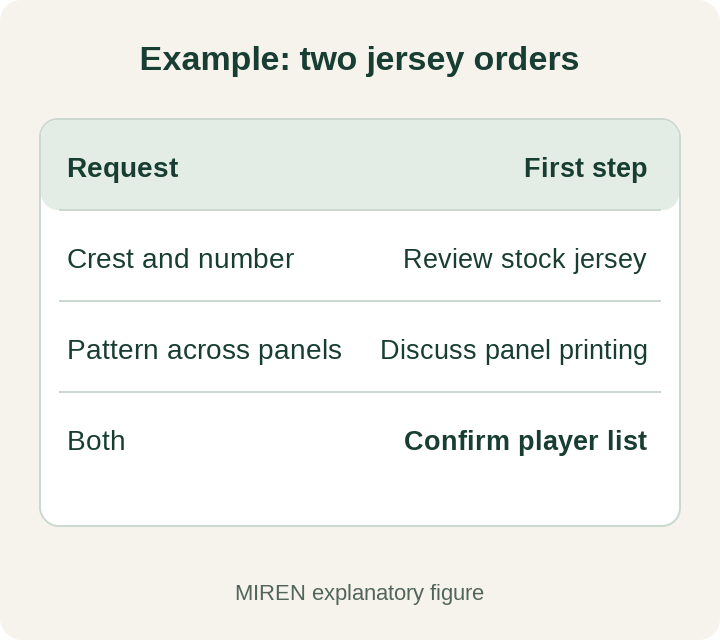
Imagine a club already owns unmarked navy jerseys. It needs a crest on the front and a player number on the upper back. Draw the two marks on a photo, specify the physical widths and get the existing jersey assessed for DTF. The request is to add selected artwork to the garment already owned. Its background and existing seam placement are fixed. Now imagine the same club wants a diagonal design that starts under the left arm, crosses the front and continues into a matching back panel. The front and sleeves need printed coverage as part of the design. Ask a specialist about a compatible polyester base and how the supplier will print and match the panels. Decide how it will vary the design by size before quoting. These two examples explain the choice and do not describe previous MIREN orders.
| Request | First decision |
|---|---|
| Crest plus number on stock jersey | Assess the actual garment for local DTF |
| Diagonal print across front, back and sleeves | Discuss compatible panels with a sublimation specialist |
Keep names, numbers and future orders linked to the spec
Create one row for each player or anonymous team code. Add the garment size, selected front and back artwork, number and name when needed. Check obvious transpositions such as 16 and 61, compare special characters at size and have the organiser approve a final list. If you need to use different placements for captains, staff or goalkeepers, identify each variant with the same format. Keep the supplier's model, fabric and layout details for later orders. For a ready-made jersey, ask what may change when stock is replenished. For a printed kit, confirm the source pattern and panel approval used for each version. MIREN can add names or numbers for an additional charge on a suitable DTF job. Its 15-piece minimum also applies to repeat orders. Those terms apply to MIREN's work, not other suppliers' methods.
Ask for a realistic confirmation
Ask to see the actual fabric and a physical reference at the intended artwork scale where available. A global rendering shows design intent but may not reveal how a mark looks near a sewn seam or over an existing pattern. With DTF, check the panel and proposed mark together and share any care requirements. With a full-panel design, discuss seam transitions and visible sample areas before approving. Write down what the proof settles. For example, it may settle which number goes with which shirt or where a logo begins. Record any material uncertainty separately so the team does not assume an attractive rendering confirms all of the fabric, colour and fit decisions.
Send the local marking enquiry with model and artwork
For a DTF enquiry to MIREN, include the ready-made jersey's model, colour, label photo, planned positions, files, size and name list, and the date the team needs the order in hand. State any existing design and whether the planned area is solid or mesh. If your primary requirement is an all-over polyester design, use the panel sketch to discuss that job with a dye-sublimation specialist. Keep your team design drawing with the version of the size and number list that the organiser has approved.
Before you contact a printer
- Map the crest, names, numbers and coverage on the garment.
- Identify whether the base shirt already exists or will be made.
- Show the actual label, panel, colour and any existing decoration.
- Confirm sizes, names and design revisions together.
- Choose a proof that answers the outstanding placement or panel question.
Frequently asked questions
Do small names and numbers require an all-over jersey?
They are local design elements. Ask about DTF if the existing jersey and placement are suitable; a new kit can also integrate them through its own supplier workflow.
Can a fully patterned jersey receive another mark?
Have the existing printed area and substrate reviewed. Colour migration, panel construction and competing artwork may change the choice.
Does MIREN offer both methods?
MIREN produces DTF. Ask a separate specialist about an all-over dye-sublimated jersey when that is the primary requirement.