
How Many Spare Staff Shirts Should You Keep?
Plan staff uniform reserve stock by shirt model, colour and size. Work through a reorder example and avoid treating every spare as interchangeable.
Build staff shirt reserve stock by model, colour and size. Start with shirts already assigned to people, then estimate demand from hires, exchanges and replacements before the next feasible order arrives. Count only usable, unassigned shirts as reserve. Use actual issue records to change your next estimate instead of adding the same percentage to every size.
Separate today's distribution from future requests
A production order may cover the shirts you intend to issue now and extra shirts you will hold for later. Put those two lines in the plan from the beginning. A name already assigned to a new starter a week from today is known demand, even if the shirt remains folded on a shelf. A piece kept for an unknown later hire is reserve. This distinction prevents counting one piece both as assigned and as available.
Define what the reserve is intended to cover. One company may need replacement shirts across several months, while a café opening a branch may mainly need items for a known onboarding period. The timeframe changes the question. Estimate separately for each programme if the garments, colour or branding differ. A reserve for back-of-house staff might be unsuitable for a customer-facing branch even though its size label is the same.
Start with actual people and recent movement
Write down how many confirmed staff still need shirts by model and size. Next record known start dates and outstanding exchanges. For uncertain demand, review your own past issues over a comparable period. How many staff started? Which sizes went out? Were most replacements for damaged shirts, a one-off event or regular wear? You want to distinguish an unusual campaign from the requests likely to repeat.
If you have no issue history, use a provisional small allocation agreed with the people who will manage the stock, then review it after the next cycle. Consider what happens when you cannot immediately issue a matching shirt and which groups are hardest to cover. If the design is due to change soon, make the reserve decision separately for the outgoing and incoming designs. Large amounts of an outdated uniform cannot solve a shortage under the new brand.
Track the garment combinations that are interchangeable
Use a row for each combination that a staff member could actually wear, such as navy polo, model P, medium, front logo version 2. A medium shirt of another cut or a previous logo version can sit on the same shelf but has a different purpose. Confirm whether the team has explicitly accepted substitutes. Once a substitute is approved, keep that decision with the row rather than letting the stock list silently merge unlike items.
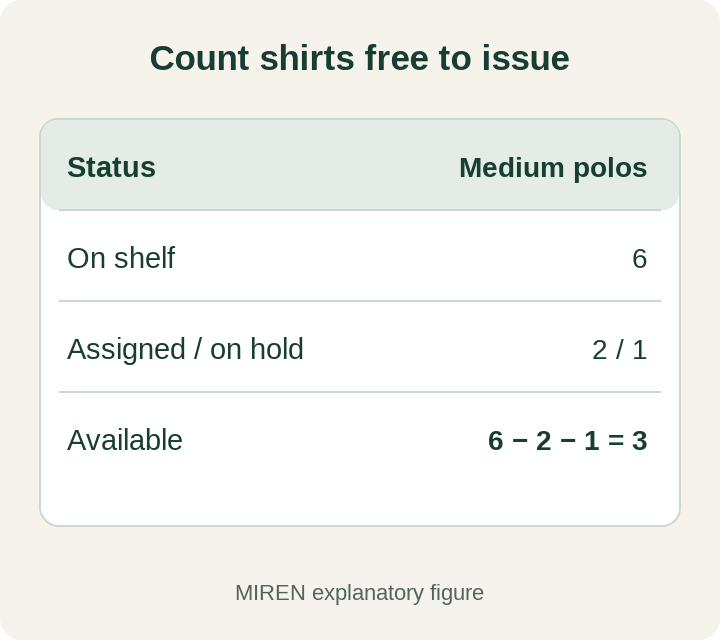
Track usable quantity, pieces already reserved for people, and pieces that cannot yet be issued. For example, if six medium shirts sit on the shelf but two are assigned and one must be checked for damage, only three are free to issue. The count should answer a practical question: how many shirts can the manager issue right now without taking something promised to someone else?
Set a review point with a worked example
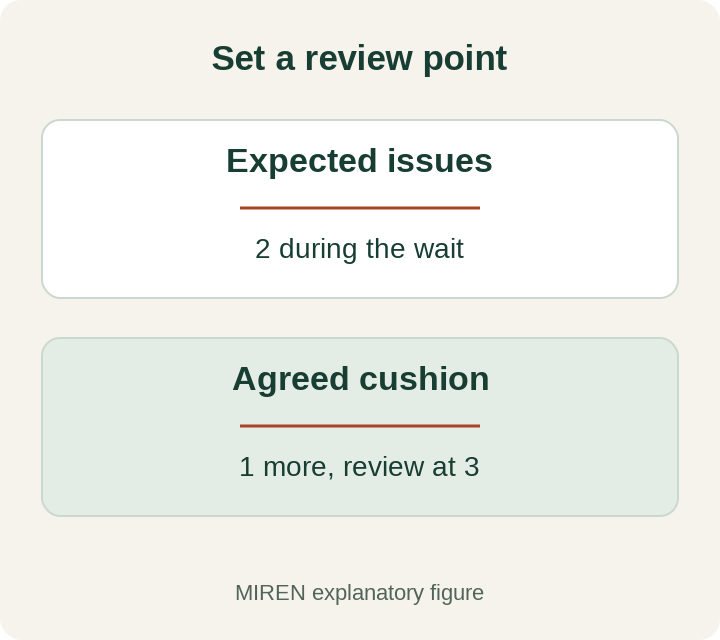
A simple planning rule is to review a row when its free stock falls to or below the number you expect to issue while waiting for the next usable delivery, plus an agreed cushion. The waiting period begins when your team starts the purchase decision and ends when the garments can actually be issued. Include internal approval, confirmed production, transit and receiving checks. Check when the people who approve the purchase are available as well. If your team only places orders on Fridays, include the wait until the next purchase window when you estimate coverage.
For example, suppose your team expects to issue two medium polo shirts during that period. You add a cushion of one. Your review point is three free shirts. In the shelf example with three free pieces, review the plan now. This hypothetical calculation is a cue to assess demand and ordering options, not a prediction or a rule that tells the shop how many it must make.
| Item | Quantity |
|---|---|
| On shelf | 6 |
| Assigned | 2 |
| Awaiting check | 1 |
| Free to issue | 3 |
| Review point | 2 + 1 = 3 |
Treat the review point and the order quantity separately
Compare expected requirements across your other clearly compatible rows before forming a reorder. An internal shortage of one size does not change MIREN's minimum of 15 pieces. Ask the shop to check the actual combination of model, colours, sizes and artwork. When stock is only needed for a few people, a buyer may be able to wait for other confirmed requirements or use an approved temporary option from its own stock. The team should decide before promising a date to staff.
Keep known issues and forecasts visible in the next order request. One grouping may reach a review point while there is no immediate demand in another size. Adding unrelated items just to reach a minimum can leave the company with excess stock it cannot use. Discuss the mix and the available models first. If the existing supplier no longer offers the exact model or colour, ask whether the proposed replacement should have its own row.
Choose where the reserve can be counted and issued
If several branches share the same uniform, keeping one reserve can make a rarely used size easier to track. Branch stock may reduce the time needed to issue a shirt, but it gives each location its own count and requires records for transfers. Decide based on who can count the items reliably and how long it takes to get a piece to a branch when somebody needs one.
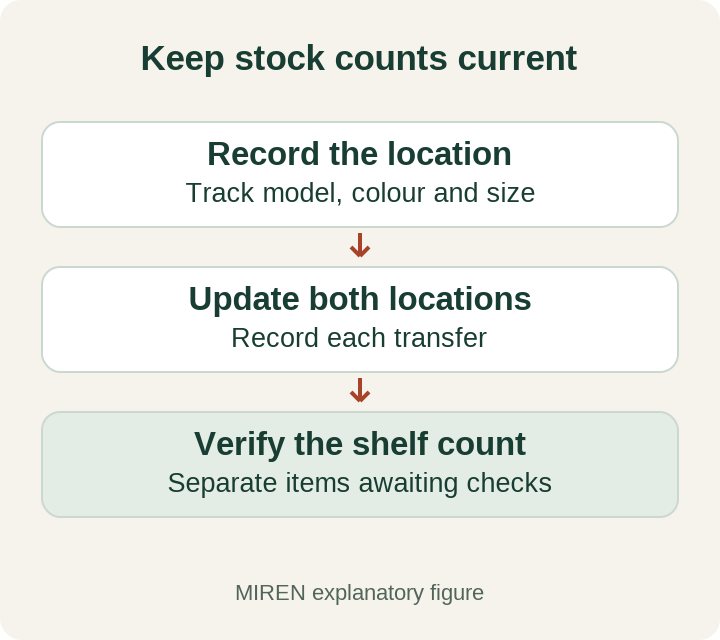
Keep one location and one status for each stock row. When a branch takes a shirt from the reserve, record both the sending and receiving entries. When a staff member returns a shirt, put it in an awaiting-check group before returning it to available stock. A box marked reserve is only helpful if people can see the models and sizes inside without relying on a past chat message.
Count regularly and learn from what gets used
Pick a review frequency that fits actual movement. At each review, compare the shelf count with the register and investigate corrections before changing estimates. Mark each issue with the date and reason, such as new starter, exchange or replacement. If a size is repeatedly overstocked while another goes out quickly, adjust those rows for the next period. Treat bursts from branch openings or uniform changes separately so they do not inflate routine forecasts.
Keep updated art and garment references with the reserve. If the brand changes, confirm what may still be issued and where, then separate those pieces physically. Before the next purchase, check the actual stock rather than copying an old order. A small, accurate list with a responsible owner helps the team avoid last-minute decisions that are based on units already assigned or damaged.
Bring a usable reserve plan when asking for a quote
Send the approved logo, the garment references and counts by model, colour and size. Identify the pieces intended for people already on the list and the additional pieces to hold. If you need several destinations, include the main receiving location and timing. Give the date when the first new starter or branch needs a complete set, so the team can discuss arrival separately from dispatch.
MIREN PRINT offers in-house DTF printing from 15 pieces. For a replenishment, bring the former model or reference photo and the current artwork details, then check current availability and the price for the new order. Use the site's reorder guide once a purchase is ready. The reserve record helps you decide when to have that conversation and which exact rows to include.
Before you contact a printer
- Sizes and quantities confirmed for known wearers
- Available, assigned and hold stock counted separately
- Expected demand during the complete wait for a new delivery
- One review point for each meaningful garment combination
- Owner, location and dates for the next check
Frequently asked questions
What percentage of spare uniforms should we buy?
Use your own issue history and how long replenishment takes. The same percentage across sizes does not reflect which garments are requested most often.
Are returned shirts automatically available stock?
Check the returned item's condition, model and artwork first. Only add it to available stock when somebody confirms it can be issued again.
Does reaching our review point mean we need to order that number?
It is a trigger to check quantities and timing. Order quantity depends on your needs and the supplier's terms. MIREN has a minimum of 15 pieces and confirms the requested mix per order.