
Changing the logo on staff shirts: plan the uniform switch by date and branch
Use an approved logo version, count existing uniforms and decide when each team cuts over. Includes a worked phased rollout and branch sign-off checklist.
Set the logo change date, count staff shirts by old and new design, and give each branch a clear last date for issuing the old version. Use one approved artwork file for the new design and keep it separate from old stock records. An immediate switch suits teams that will be seen together on launch day. A phased rollout is easier to manage when the company allows different teams to switch on different dates.

Decide when the new logo must first appear
Start with the first occasion on which the new branding must be visible. It could be the day the public signage changes, an event at a flagship location or the start of a campaign. Find out which people will be present and whether they all need the new version. Give people in charge of uniform issue a date and a list of the affected teams. A marketing launch date alone does not identify who needs a shirt in hand. Write down what happens on the following shifts as well as on the first day. An employee who works two branches may be subject to both locations' instructions. Decide which rule takes precedence and how supervisors will handle casual workers and new starters. A single, clear instruction for each person or shift is more useful than a broad reminder to “start changing shirts next month”.
Count older shirts by version and state
Make a record of the logo version, garment model, colour, size, location and status. Count shirts already issued separately from shirts still in stock. Locate promised replacements and new starter sets. Those allocations count towards the affected teams. If shirt versions look alike from across a room, add a photograph of both marks to the record showing the identifying difference. Record which items are already agreed for a final round of use, which are held back and which need a decision from the company. Two branches might both report five navy shirts in reserve. One list might describe five from the old logo and the other five from the new design. Version labels keep those figures useful without requiring every supervisor to recognise the artwork from memory.
Choose a single launch or a phased change
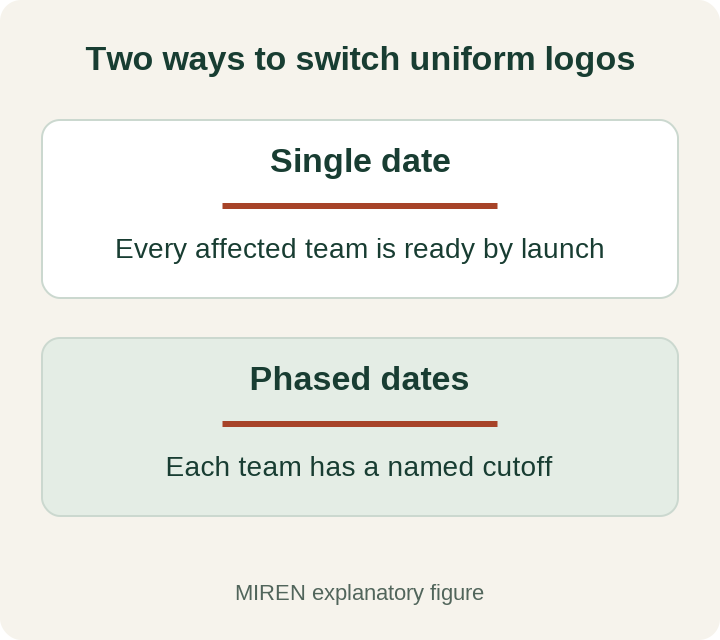
For a single launch, work backwards from the event and make sure every affected team has the correct shirts for distribution beforehand. Include time for counting and getting the shirts to each location. Record who can confirm readiness. This approach makes sense if staff from different branches will appear together in front of customers from day one or if the business has set one uniform policy date. For a phased change, pick an explicit date for each team. Decide whether old-logo stock can be issued until a cutoff and on what terms employees may wear it during the transition. For example, public-facing staff may adopt the new design first, while an office not included in the launch changes later. Confirm that the business is comfortable with both versions being in use and give each location a named contact for exceptions.
A phased rollout works best when staff can tell which instructions apply to their next shift. Put the new-logo date and the last old-logo date next to each other in the supervisor’s schedule. For teams that move between sites, record both the home branch and any customer-facing assignment on launch week. If the launch date moves, ask the supervisor to confirm the revised timeline before informing staff. Otherwise an old message in a branch chat can create two different start dates.
Work through a two-wave rollout
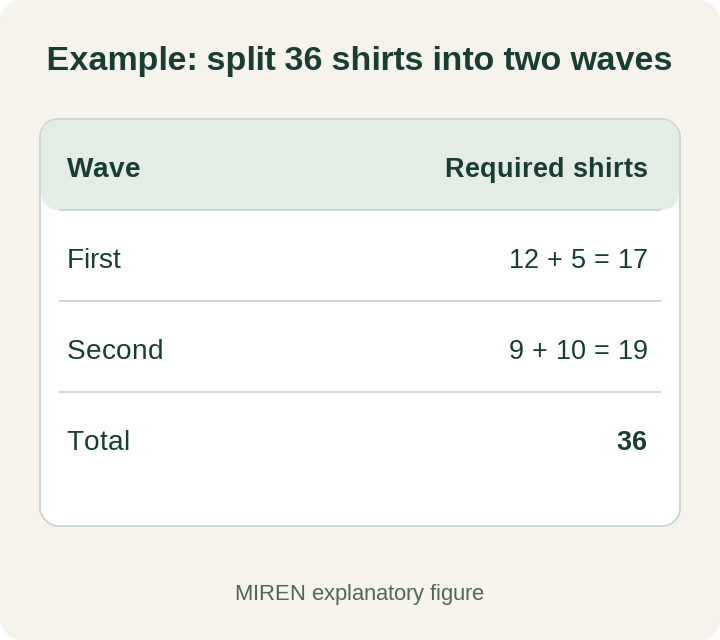
Suppose a hypothetical business wants 36 shirts for three locations and a central training group. Those quantities are 12 for Branch A, 9 for Branch B, 10 for Branch C and 5 for training. Branch A and the training group attend the launch together, so they account for the first 17 shirts. Branches B and C switch later and account for the remaining 19. The counts represent launch requirements, before any decision about reserve stock. Write two separate lines in the release plan even if both waves are placed in one purchase. Put the date, size list, destination and named approver against each wave. The second wave can have its own issue date without requiring a separate production order. If the buyer instead wants separate production runs, confirm how the shop applies its minimum and check both dates independently. MIREN's minimum is 15 pieces per order.
| Wave | Team | Qty |
|---|---|---|
| 1 | A + training | 12 + 5 = 17 |
| 2 | B + C | 9 + 10 = 19 |
Keep one approved design per garment group
Request the original marks and channel any size or colour questions through one person who can approve the current version. Label the old logo as archived in the work folder. Put the new version on a proof with the garment model, colour, print position and width. A simple file label such as Staff-Chest-New-R02 can help, but the written approval should also identify the attachment. If the new logo changes shape, the old print dimensions might no longer suit the placement. A wide wordmark next to a pocket may need a different position from the old round mark. On polos, MIREN assesses the actual model and placement. Check any design variant for dark or light garments alongside the main proof. Store the exact files for each approved variant so that the next order stays consistent.
Write the instruction for remaining old-logo stock
If the business allows it, identify the planned use or destination of the older garments. Examples might include retaining an archival sample or using an agreed last-issue period before the change. Policies around old branded uniforms differ by organisation. Agree the handling internally and record the person who can answer questions instead of leaving open stock for local interpretation after the switch. Tag cartons and update the inventory before the new ones arrive. An old batch and a new batch with the same model, colours and sizes can be easy to mix up. Use clearly different labels and ask branch managers to update the stock list when they hand shirts to staff or transfer a carton. Note what should happen if a shortfall is found after the old version is no longer authorised for use.
If the team wants to retain existing uniforms, assess the physical logo and allowed replacement options before committing the batch.
Confirm that the right people have the right version
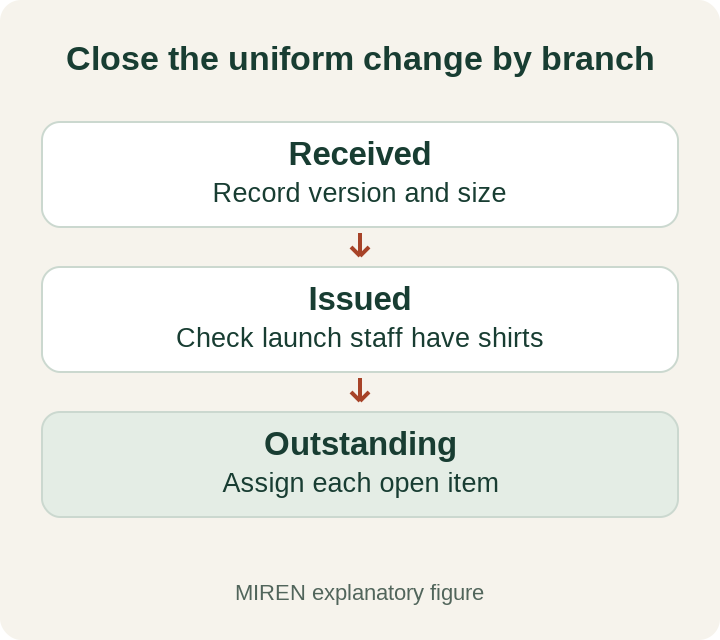
Ask each lead to report three things: shirts received by version and size, shirts issued, and unresolved needs before the switch. A carton delivered to Branch A is useful information. Confirmation that all launch workers have the new logo in their size is the next check. Use a short status list so you can still act on a mismatch or a staff member who was left out. Record the first date on which each team actually uses the new version and close any difference from the plan. Keep the approved proof and current artwork accessible for routine staff orders. Move any old artwork to an archive that makes its status clear. An easy ordering path for the new model reduces the risk of accidentally reviving the old version on the next replenishment.
Give the approver a compact status update that separates timing from quantity. A note such as “Launch group confirmed, two later sizes waiting for exchange” lets the project lead decide whether the first wave can proceed. Ask the branch with the open issue to record the owner and the next check date.
Ask about production with a clear cutoff
Send MIREN the new artwork and the required date for the earliest group. Include the garment model, quantities, colour variants and print position. Orders are typically dispatched 3–10 days after artwork approval and deposit payment, depending on quantity. Once you know which teams have the tightest date, ask how the agreed dispatch plan fits the date each team needs its shirts in hand.
Before you contact a printer
- Name the customer-facing date and teams that need the new logo first.
- Record old and new stock separately by model and size.
- Choose launch or phase dates and name an approver.
- Confirm one designed proof per garment group.
- Ask each branch to confirm actual receipt and issue in time.
Frequently asked questions
Can we keep issuing old-logo staff shirts during a rebrand?
Follow the company's agreed dress and branding rules. Give every team a written cutoff date, and record any approved exception.
Should two waves have separate purchase orders?
A single confirmed order can contain both groups if the purchasing and delivery arrangements allow it. If procuring separate batches, check the shop's minimum and the timing for each.
Should we keep using the old logo size?
Reassess the width and position against the new design and garment. A shape change can make a previously suitable area more crowded.